Category Archives: Club News
News items about the club (Outreach projects, New members, Field trip planning, meeting reports, etc).
November 2018 Nightfall Newsletter is now available
The November 2018 edition of the Huachuca Astronomy Club newsletter, Nightfall, is now available for download. Submissions for next month’s issue can be sent to , our Nightfall editor
October 2018 Nightfall Newsletter is now available
The October 2018 edition of the Huachuca Astronomy Club newsletter, Nightfall, is now available for download. Submissions for next month’s issue can be sent to , our Nightfall editor
Kartchner Star Party – Saturday, October 13
“Camels in the Sky: Our Heritage of Arabian Star Lore”
Saturday, October 13 at 5:30 in the Discovery Center.
 Dr. Danielle Adams, a recent graduate from the School of Middle Eastern and North African Studies at the University of Arizona and NASA Space Grant fellow, will speak about the rich star lore of Arabia as it was more than a thousand years ago. Camels, vultures, goats, wild cows and many other kinds of animals graced the skies of the Arabian desert, and some of these survive in the star names used by astronomers today. Danielle will especially focus on the stars that are visible in the fall so that visitors can find them after the talk in the park’s famously dark sky. Some of these stories can be found on her website, onesky.arizona.edu.
September 2018 Nightfall Newsletter is now available
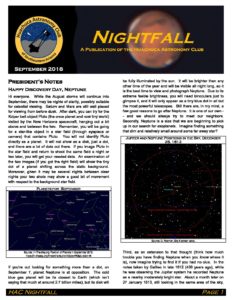
The September 2018 edition of the Huachuca Astronomy Club newsletter, Nightfall, is now available for download. Submissions for next month’s issue can be sent to , our Nightfall editor
August 2018 Nightfall Newsletter is now available
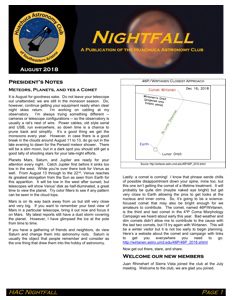
The August 2018 edition of the Huachuca Astronomy Club newsletter, Nightfall, is now available for download. Submissions for next month’s issue can be sent to , our Nightfall editor
July 2018 Nightfall Newsletter is now available
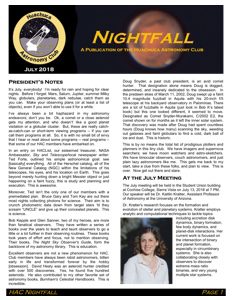
The July 2018 edition of the Huachuca Astronomy Club newsletter, Nightfall, is now available for download. Submissions for next month’s issue can be sent to , our Nightfall editor
June 2018 Nightfall Newsletter is now available
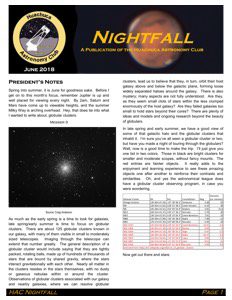
The June 2018 edition of the Huachuca Astronomy Club newsletter, Nightfall, is now available for download. Submissions for next month’s issue can be sent to , our Nightfall editor
June Guest Speaker: Dr. Chad Bender
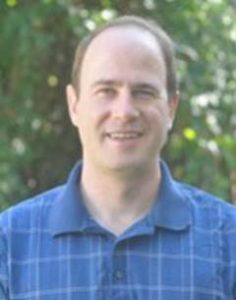 The meeting will be held on June 8th in the Student Union Building at Cochise College 901 N. Colombo Avenue, Sierra Vista at 7pm
Dr. Chad Bender studies exoplanets to improve our understanding of how planets and planetary systems form and evolve. He and colleagues are currently building a pair of spectrometers that will search close- by stars for Earth sized planets that might be capable of supporting life.
Dr. Bender received his Ph.D. in 2006. He is currently an Associate Astronomer at The University of Arizona’s Steward Observatory
The first exoplanets discovered in 1993 paved the way for an astronomical revolution. The subsequent 25 years have revealed thousands of planets orbiting stars, with a diversity of characteristics not seen in our Solar System, nor even previously imagined. Over the past decade, astronomers have pushed detection sensitivities towards smaller and smaller planets and are now finally at the cusp of discovering Earth like planets around nearby stars. Dr. Bender will describe some of these discoveries, and the cutting-edge instrumentation and surveys that are finding them.
May 2018 Nightfall Newsletter is now available
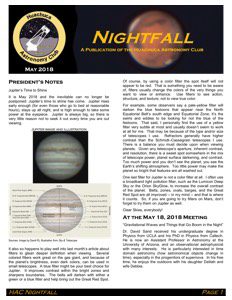
The May 2018 edition of the Huachuca Astronomy Club newsletter, Nightfall, is now available for download. Submissions for next month’s issue can be sent to , our Nightfall editor