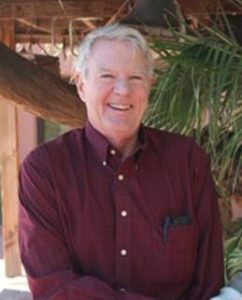
 Dr. Hunter has been an amateur astronomer since 1950. He built and operates the Grasslands Observatory near Sonoita, Arizona. In 1987, Dr. Tim Hunter and Dr. David Crawford founded the International Dark-Sky Association, Inc., to promote quality outdoor lighting and combat the effects of light pollution. He is the chair of the board of trustees for the Planetary Science Institute and past president of the board of directors of the International Dark-Sky Association. In addition, he is a retired professor and former chief of the Department of Radiology in the College of Medicine at the University of Arizona. He earned an M.D. degree from Northwestern University in 1968. He also received a Bachelor of Science degree in mathematics from the University of Arizona, and he recently completed a Masters degree in Astronomy from Swinburne University. Dr Hunter holds a number of prestigious awards including to 2003 Astronomical League Award.
Club Meeting Announcement for March 2017
The next meeting of the Huachuca Astronomy Club will be held on Friday, March 10th at 7 pm in the Community Room of the Student Union Building at Cochise College, 901 North Colombo Avenue, Sierra Vista, AZ 85635. The speaker will be Dr. Tim Hunter.
Dr. Hunter will discuss Barnard objects. The astronomer Edward Emerson Barnard compiled a list of dark nebulae known as the Barnard Catalogue of Dark Markings in the Sky. The 1919 version of the catalogue was published in the Astronomical Journal, and it listed 182 nebulae, and by the 1927 version, it listed 369 dark objects. One of the more well known dark objects is Barnard 33, also known as the Horsehead Nebula.
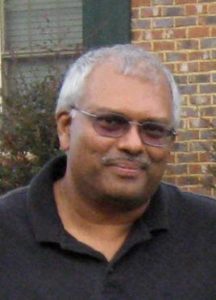 The speaker will be Dr. Nalin Samarasinha, a Senior Scientist at the Planetary Science Institute in Tucson.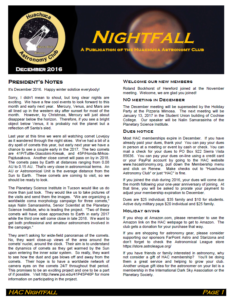
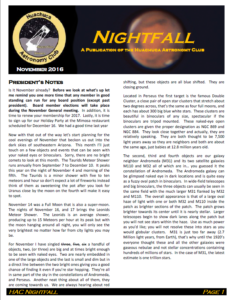
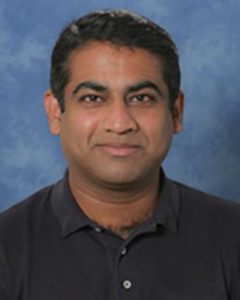 The speaker will be Dr. Vishnu Reddy, an assistant professor at the Lunar and Planetary Lab at the University of Arizona in Tucson.